Showing posts with label Mindlab. Show all posts

Monday, 19 March 2018

Key change in my professional practice


Mindlab Activity 8: Key change in my professional practice

Step 1 (What): Identify one key change in your professional practice

Two key changes that I have made in my professional practice has been developing my ‘Professional learning’ which is to use inquiry, collaborative problem-solving and professional learning to improve professional capability to impact on the learning and achievement of all learners and ‘Teaching’ which is to teach and respond to learners in a knowledgeable and adaptive way to progress their learning at an appropriate depth and pace (Ministry of Education, nd). By inquiring into my own teaching, I have been able to identify areas that are needing development.

Step 2 (Now what): Evaluate the identified change

Stage 1: Problem identification

The problem that I have identified was the slow shifts I was seeing in my students Mathematics development. My students weren’t progressing at the same level other students in our school has been progressing, and I wanted to know what I could do to turn this around. What approaches are others using that is successful?

Stage 2: Observation and analysis


I have found that at times my explanations weren’t clear, and what seemed straightforward to me, was utterly confusing for my students. Also, I tended to keep my maths groups progressing at relatively the same speed, therefore students that grasps a certain concept quickly, maintained with the group and wasn’t pushed to excel further. This was to keep my teaching neat and tidy, but was of no benefit to my students.

Stage 3: Abstract re conceptualization

At this stage, I have considered using flipped learning in my classroom. This would allow all explanations to be carried out effectively from well sourced materials, but at the same time, allow students to work at a pace suited to their needs. This gives my students that need an extra push, time to work through at their own pace, as well as boosting those students that are raising ahead.

Stage 4: Active experimentation

I believe that flipped learning is not a means to an end, but will support my teaching. I have to further inquire as to how this may look in my classroom and how to get the most out of this strategy. As I like to know what each student is doing, where they are at, flipped learning creates some challenges for me. This is future learning for myself to consider.

Step 3 (What next) Share your next plan(s) regarding your future professional development or your future practice.

I want to continue exploring flipped learning and how I can best utilize this strategy and how to best manage students using flipped learning. What other areas of my teaching could benefit from flipped learning?

References

Ministry of Education (nd). Our code, our standards. Retrieved from https://educationcouncil.org.nz/content/our-code-our-standards

Indigenous Knowledge and Cultural RESPONSIVENESS

Mindlab Activity 7: Indigenous knowledge and cultural responsiveness in my practice

According to Milne (2017) “cultural identity is not a thing that needs to be celebrated on certain occasions such as cultural weeks, rather teachers and school should embrace student cultural identity at every opportunity throughout curriculum and learning activities, school policies and events”. The school I’m currently at strives to improve the achievement for Maori students. Although it has been a priority for many years, more effort has been made in the last three years to promote the learning and success of all our Maori students. Our principal has set up a group MASAM, Maori Achieving Success As Maori, and invites whanau and the community to bring forward their ideas and suggestions as to how we can successfully support our Maori Students. These meetings as held monthly and are open to anyone wanting to join in.

From these meetings, we have decided on our school vision statements, policies, goals and school values which encompasses our Maori learners needs. From here, we are able to plan accordingly and seek funding if need be from our BOT for suitable learning activities, and/or resources.

As a staff, the area that is lacking, is Te Reo Maori. Teachers have all been a part of Tikanga Maori courses, our latest being with Tamsin Hanley regarding “Te Ao Maori”. This year we are further developing the language spoken and increasing our understanding and pronunciation of commonly used words and phrases. We are partaking in Te Reo professional development through The Ministry of Education.

As a teacher, I pride myself in the knowledge I have already obtained of the Maori culture and language and strive to continue learning. I am of South-African background, having moved to the United States at the age of 14, and then finally to New Zealand at the age of 17.

Using ‘The Action Continuum” from Milne’s presentation (CORE Education, 2017), I would say that at our school, the majority of our teachers and the management of our school currently lies within the green area - Indigenous and culturally centred, structures and practice are embedded but still colonial.

As a school, we need to continue our own professional development of Tikanga Maori and Te Reo Maori. Further to this, we need to provide our Maori students opportunities to share their experiences and knowledge with the class, and allow more student agency. Continue the home-school partnerships that have been established, and endeavour the strengthen the weaker partnerships.

References

CORE Education.(2017, 17 October). Dr Ann Milne, Colouring in the white spaces: Reclaiming cultural identity in whitestream schools.[video file]. Retrieved from https://www.youtube.com/watch?v=5cTvi5qxqp4&feature=em-subs_digest

Milne, A.(2017).Coloring in the white spaces: reclaiming cultural identity in whitestream schools. New York: Peter Lang Publishing, Inc.

Contemporary trend in New Zealand or internationally

Mindlab activity 6
Step 1 (What): Identify one trend that is most relevant to your practice:
The trend that captivates my attention, along with most of the other Mindlab-ers is the rate at which technology is taking over in society. As a child I always thought it would be great to have a shop where you can scan your own items and pay for them.  This I thought was a fairytale, and far from ever being real. Within 10-15 years, this was a reality. And it didn’t just stop here, now you don’t even have to physically go to the shops, online shopping is so easy and convenient.
When I started teaching 8 years ago, our school had 6 desktops that were being utilised amongst 100 students. Being a bit of a techy nerd, I pushed for our school to increase the devices we had available for student use. At first, many of my colleagues wanted nothing to do with our new C.O.W. (Computers On Wheels). The C.O.W. permanently lived in my room, and my students very quickly learnt how to log on, log off, type, search the web and e-mail. My colleagues quickly noticed the student engagement with learning when using technology and wanted in.  At this stage, we were only using the technology as a substitute for the old ways we did things.
Step 2 (So What): Analyse the trend
With the change in technology, jobs are no longer safe. Artificial Intelligence (AI) is quickly taking jobs from people that require repetitive movements, or predictable outcomes. For example, self checkouts, ATM’s, robots in car manufactures, etc.
As A teacher, I would hope that my job would be secure in the future, however there are some jobs a Robot could do to replace some of the tasks teachers are required to fulfill, e.g, assessments, playground duties, planning (to some extent), marking (closed questions), etc. There are also some areas of teaching where AI would make ‘better’ teachers compared to humans for example non-judgemental criticism from teachers. Many other teachers, (as I read through others’ blogs), identify some of the main characteristics that computers do not possess, which is important to be a successful teacher that makes a difference. “While machines can handle a variety of specific tasks, we haven’t yet come close to creating artificial general intelligence (AGI) — the kind of machine that could answer the tough questions outside the purview of the immediate lesson that good teachers should be prepared to tackle. Today’s robots also lack the empathy and ability to inspire that teachers bring to the classroom” (Houser, 2017).


Step 3 (Now What):
With this increasingly growing trend, students these days no longer require to be taught information, but rather how to find information needed, problem solve and to work collaboratively. I’m needing to prepare my students for a future I know nothing about, and can’t begin to predict what skills are needed for them to be successful in the future. I need to prepare my students to be adaptable, and to think outside the square. I need to prepare them for jobs that do not exist yet.
References


Houser, K. (2017). The solution to our education crisis might be AI. Futurism. Retrieved 18 March 2018, from https://futurism.com/ai-teachers-education-crisis/

Monday, 5 March 2018

Professional Online Social Networks

Mindlab Activity 5
Step 1
How have you used social media tools in your teaching/professional development?
  • I use Facebook as a way to connect with other educators. I have joined to a variety of ‘communities’ to support my own professional development. Reading through others’ questions and related answers, discussions or responses, helps to form my own understanding of certain concepts or areas of development.


What characteristics of the social media you have you harnessed in your teaching/professional development context?
  1. Create, share, adapt and reuse content;
  2. Engage in digital dialogue and collaboration
  3. Create linkages, groups and communities,
  4. Social interactions with other users.


Step 2
How could social media be used to benefit the teaching and learning?


  • Professional development, discussion with other teachers to seek advice and support, seek feedback and different viewpoints regarding professional/teaching issues/dilemmas, etc.


What are potential challenges that teachers need to be aware of when they are integrating social networking platforms into teaching activities?


  • Privacy
  • Cyber bullying
  • Inappropriate content - videos, photos, comments
  • Religious/personal views of parents/whanau
  • School cyber safe policies


Step 3
What are the implications for using social media in teaching and/ or professional development?


  • When using social media in a safe, cyber smart way, teachers are able to enhance teaching and learning for the students as learning become more authentic and connected. Students are able to connect to the world in ways not possible before technology.
  • Teachers are able to connect and seek feedback from teachers all around the world, being exposed to varying viewpoints and ideas regarding any particular topic. By considering the viewpoints of others in our own country and around the world, teachers are better able to make decisions that will impact students learning in positive ways.


In what ways does this reflective process inform and change your perspective?


  • It makes me think about ways that I could use social media in the class.  I have always used social media to support my own professional development, however have not considered using it with my students. I always thought social media would be more beneficial for intermediate aged students and older, however after watching the Video realise just how powerful it can be with students of any age.
  • This term in my class our students are writing to their penpals in Ireland. They are handwriting their letters and sending using snail mail. This is a great way of connecting with people from around the world and broaden their understanding of the world around them.  This learning could further be deepened by connecting with these students on a digital platform where dialogue and itneraction is immediate.  

Sunday, 25 February 2018

Influence of Law & Ethics in Practice


Mindlab Activity 4

1 (What): An ethical dilemma that I have faced in the past is very similar to one of the issues discussion in one of the videos from this week's required activities, and relates to students being photographed/videoed and shared on social media.


At my school, we ask permission upon enrollment of students, for their child to be published on our school website, newsletters, school facebook page and pictures displayed around the school. A parent approached me oneday, annoyed, saying that 'their' child was on our school Facebook page and they were not happy about this. Originally they had signed for their child to be published online, but didn't think this meant social media. They further complained that other parents were taking photos at sports days, which included 'their' child, and were posted on social media. This was seen a more of a problem, as it was not only on our School Facebook page, but individual parents Facebook pages, which we had no control over.


Step 2 (So What): According to Ehrich, Kimber, Millwater & Cranston (2011) the following should be considered when being faced with this dilemma: professional ethics, legal issues or policies, organisational culture, the institutional context, the public interest, society and community, the global context, the political framework, economic and financial contexts. In my case, I went straight to find the original document that the parent had signed, to see if in fact ‘they’ had given permission for us to publish photos online - which they had. I further considered our organisational culture, the public interest, our local and wider community(ies), and asked myself whether removing all photos of this particular child was the best plan of attack.


Before moving further with this dilemma, I asked the meet with the parent again. We discussed what ‘they’ thought ‘publish online’ meant, and found it did not match the school’s description. With the parent, I discussed ‘their’ options. These included, a new form being signed saying that the school didn’t have permission to publish photos online. In doing this, ‘they’ would have to agree that he child could also not be in our school newsletters and school magazine, as these are shared with our whanau on our school Facebook page. Further to this, I posted on our school Facebook page that any photos other parents may have of students, would need to have my approval before being posted on our school Facebook page. This did not solve the issue of other parents posting pictures of their own children on Facebook, that may showcase this particular child. This was discussed as a staff at a staff meeting, with only one manageable solution, that this child be excluded from all EOTC activities.


All these solutions would allow this child to not be published online, however wasn’t being fair to the child as they would need to be excluded from many of the activities that would be showcased by the school, which included our “Caught Being Good’ Award. This would not be the best outcome for the child and they would miss out on much of what the other students would have access to.


Step 3 (Now What): The ideas were discussed with the ‘parent’, with the final decision left in ‘their’ hands. The parent decided that they too did not want their child to miss out on a quality education, and that photos in Newsletters and in the school magazine would be acceptable, because they aren’t directly loaded onto Facebook, but would prefer photos not to be loaded onto Facebook directly. As a school, we had to ensure that all parents understood our policy around photos/videos being taken, and reworded the policy to explicitly state the inclusion of Social Media as a media online.


Ehrich, L. C. , Kimber M., Millwater, J. & Cranston, N. (2011). Ethical dilemmas: a model to understand teacher practice, Teachers and Teaching: theory and practice, 17:2, 173-185, DOI: 10.1080/13540602.2011.539794

Tuesday, 5 December 2017

Communities of Practice

Mindlab Activity 3
The two topics I would like to focus my inquiry on is:
  1. Flipped classrooms - How can this work effectively in a team-teach classroom environment?
  2. Digital portfolios - How to implement digital portfolios with students for the first time and what tool/medium would be of most benefit.


  • How do the two chosen topics relate to issues in your professional practice?
Flipped classrooms have always been of interest to me. I like the idea that students are able to have a look at something in their own time, before the teaching happens in class. This is particularly useful for students that require information being ‘fed’ in different ways, or may need to hear the same information a few times.  As our senior school will be involved with the Manaiakalani project next year, our students will have one-to-one devices, allowing for flipped learning.  This then means that all the learning does not have to happen solely in the classroom. Parents can be involved with the learning also, creating a wider community of learning for the students.  This also leads into the students being able to reflect on their own learning using blogs or digital portfolios.  At the moment, our portfolios only serve the purpose of the teacher selecting ‘good’ pieces of work to showcase to parents/whanau.  I would like to see students having more ownership of their own learning (Students agency) by choosing pieces to share themselves, and reflecting on these using their blogs or digital portfolios.


  • How could Wegner’s model help you to identify some of your meaningful Communities of Practice?


Wenger et al. (2002), describes a Community of practice as a ‘group of individuals participating in communal activity, and experiencing/continuously creating their shared identity through engaging in and contributing to the practices of their communities’. He goes on further to say that “Communities of practice are a practical way to frame the task of managing knowledge. They provide a concrete organisational infrastructure for realising the dream of a learning organisation.” (Wenger, McDermott, & Snyder, 2002, Preface, para. 2). Therefore, the communities of practice I belong to include my syndicate team, Google+ Mindlab Community, Mindlab Kaitaia Community, RTLB and Manaiakalani.


  • How would inquiring on those topics contribute and link to learning within your Communities of Practice? (e.g. your team, syndicate, CoL, online community, Mind Lab whānau, professional association)


By inquiring into my two topics - flipped classrooms and digital portfolios - I am supporting my syndicate community to work towards to best outcome for our students. As a syndicate, and as a school, we strive to develop each child into achieving their goals. Providing my understanding of 21st century learning and inquiring into best practise for my two topics, I can support our students to become self-directed 21st century learners that strive for more. I can also connect with Manaiakalani, as they will be working alongside a couple of our teachers to delve into their pedagogy into our classrooms. I can share my inquiry findings with them, and they can support me in areas that need development or even areas that I may not have considered.


Wenger, E., McDermott, R., & Snyder, W. (2002). Cultivating Communities of Practice: A Guide to Managing Knowledge. Cambridge, MA: Harvard Business School Press.

Sunday, 26 November 2017

A Change in My Practice Towards Future-oriented Learning and Teaching

Mindlab Activity 2
Theme 4: "Changing the script": Rethinking learners' and teachers' roles


  • Why did I make this change?
I have always been intrigued by the thought of children ‘driving’ their own learning. I wanted students to be able to take ownership of their learning and thus creating students that are engaged and motivated about learning because they choose the path their learning is taking. I wanted to empower students to be able to learning goals for themselves, and use the reflections of those to guide future learning. In my year 2/3 class, it has been very minimal, but already I can see that my students are setting goals based on their own needs. Often, they seek feedback from peers and collaboratively work out a next step/goal.  This requires students develop self-regulatory skills. According to ITL Research (2012), “Today’s complex world demands self-regulated thinkers and learners who can take responsibility for their lives, their work, and their ongoing learning. It requires individuals to monitor their own work and to incorporate feedback to develop and improve their work products” (p.31)


  • How was this change triggered during my learning journey at The Mind Lab?
Focusing on the 21st century learning skills has supported my decision for this change. I have previously heard about self-regulation or students agency, however didn’t understand the impact it could have on my students and my teaching. By developing my first assignment, I have had the opportunity to further grow my understanding of student agency and how it would benefit my students, not only now, but also into the future.


  • What have I learned from implementing this change?
I have learnt that teaching self-regulation take times. It needs to be model explicitly to students. Students need to be given the time to practise this skill, to fail and try again. They need to be able to do this in an environment where failures are celebrated. By my students being able to set their own goals for writing, they no longer needed to be directed about what to focus on in writing. Instead of them coming to me, asking what needs fixing, they can now come to me and say, “I have used the same sentence starters for each of my sentences. I’m not sure how I can change some of these, I just can’t make them make sense”. I like the students will tell me what they need help with, rather than asking what needs improving. This allows students to think critically about their own writing and can apply to future situations where students are applying for jobs, going for interviews, etc.


At the start of next year, developing students agency is going to be my big focus. I would like to see my students leading their own learning in other curriculum areas such as reading, maths and topic studies. This could further be developed in students talking about their own learning and changing the focus of our parents - teacher interviews. Although we currently have three way conferences, the students are a little less prepared to discuss their learning with whanau as I would like.


ITL Research. (2012). 21CLD Learning Activity Rubrics. Retrieved from https://education.microsoft.com/GetTrained/ITL-Research

Sunday, 19 November 2017

Critical evaluation of my reflective practice.

Mindlab Activity 1
To be honest, written reflections are non-existent for me at the moment. I am constantly reflecting about my teaching and practice in the weirdest places - bed, shower, driving, while cooking, etc when writing things down just does not happen or practical. I often discuss concerns with peers to gain greater insight or new ideas. But critically reflecting, on paper, just isn't happening. I have tried to set time aside to complete reflections, I have bought diaries, every time they just gets pushed to the side - viewed as not important, purely because they take time, which there isn’t much going around.  


I wasn't sure how to start this blog post, so decided to have a look at what other people have said. Looks like many of us are focusing on the description, rather than the reflection. To support my critical reflection of my practice, I need to focus more on the ‘how’, ‘why’, and ‘so what’, rather than the ‘who, what and where’.


According to Zeichner and Liston’s (cited in Finlay, 2008) five levels of reflection, I would say I am currently sitting at level 2. I do from time to time ‘research’ (level 4) when I come across a challenge I have no idea how to solve, or a child with behaviour issues I can not manage. However, never have I critically reflected about this in writing.


SO


How - I am going to critically reflect using a variety of models, looking for a model that is successful and that works for me. One that is effective, but doesn’t require writing novels. Because according to Finlay (2009), “different models are needed, at different levels, for different individuals, disciplines and organisations, to use in different contexts” (p.10).


Why - Because with critical reflection, there is growth. Not only do you need to think retrospectively - what has been done, but also about what you are doing right now, and what you are going to do next time. It is with this thinking that we can ensure that we are always improving our teaching practise, looking for better, more effective ways to teach, learn and inspire others.


So what - According to Dewey (cited in Finlay, 2009) “reflective thinking moved people away from routine thinking/action (guided by tradition or external authority) towards reflective action (involving careful, critical consideration of taken-for-granted knowledge)” (p.3).


I am looking forward to making critical reflection a habit.


Finlay, L. (2009). Reflecting on reflective practice. PBPL. Retrieved from http://www.open.ac.uk/opencetl/files/opencetl/file…

Saturday, 22 July 2017

Mindlab Session 1: Leadership

What do you consider a good leader to be like?


After watching the above video, we (Mindlab Participants) discussed what we believed what we consider a good leader and a good follower?

Leader:

  • Leads in front of the class
  • Encourages people to think for themselves
  • Provide learning experiences to students
  • Stond
  • Decisive
  • Humble
  • Co-operative
Follower
  • Can follow the leader
  • Can take instruction and directions
  • Collaboration
Being a good follower, can make you a greater leader.
Leader and follower may change roles at any given time

Reflection

For my students to be leaders of learning, I need to give them opportunities to lead when I follow.


Thursday, 20 July 2017

Mindlab Session 1: Purpose of Education!

So today we had our first session of Mindlab. 

Our first collaborative task involved discussing "The Purpose of Education".

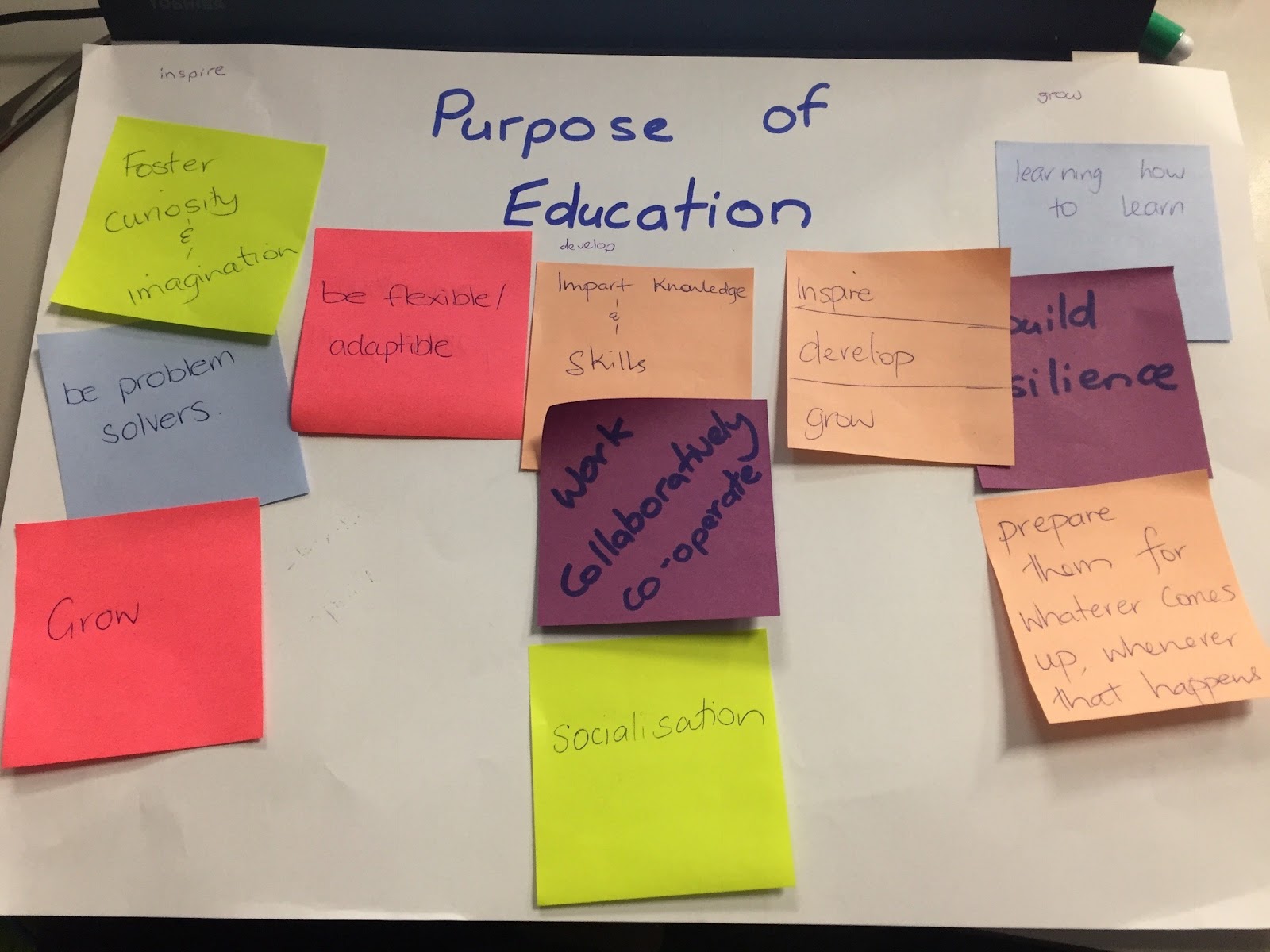
Purpose of Education - from Cheryl, Venessa, Penny and Natalie.


Our ideas included:
  • Foster curiosity and imagination 
  • To be problem solvers 
  • Grow in ourselves 
  • To be flexible and adaptable 
  • Inquire knowledge and skills 
  • Work collaboratively and co-operate 
  • Socialisation 
  • Build resilience 
  • Learning how to learn 
  • Prepare the for whatever, whenever! 
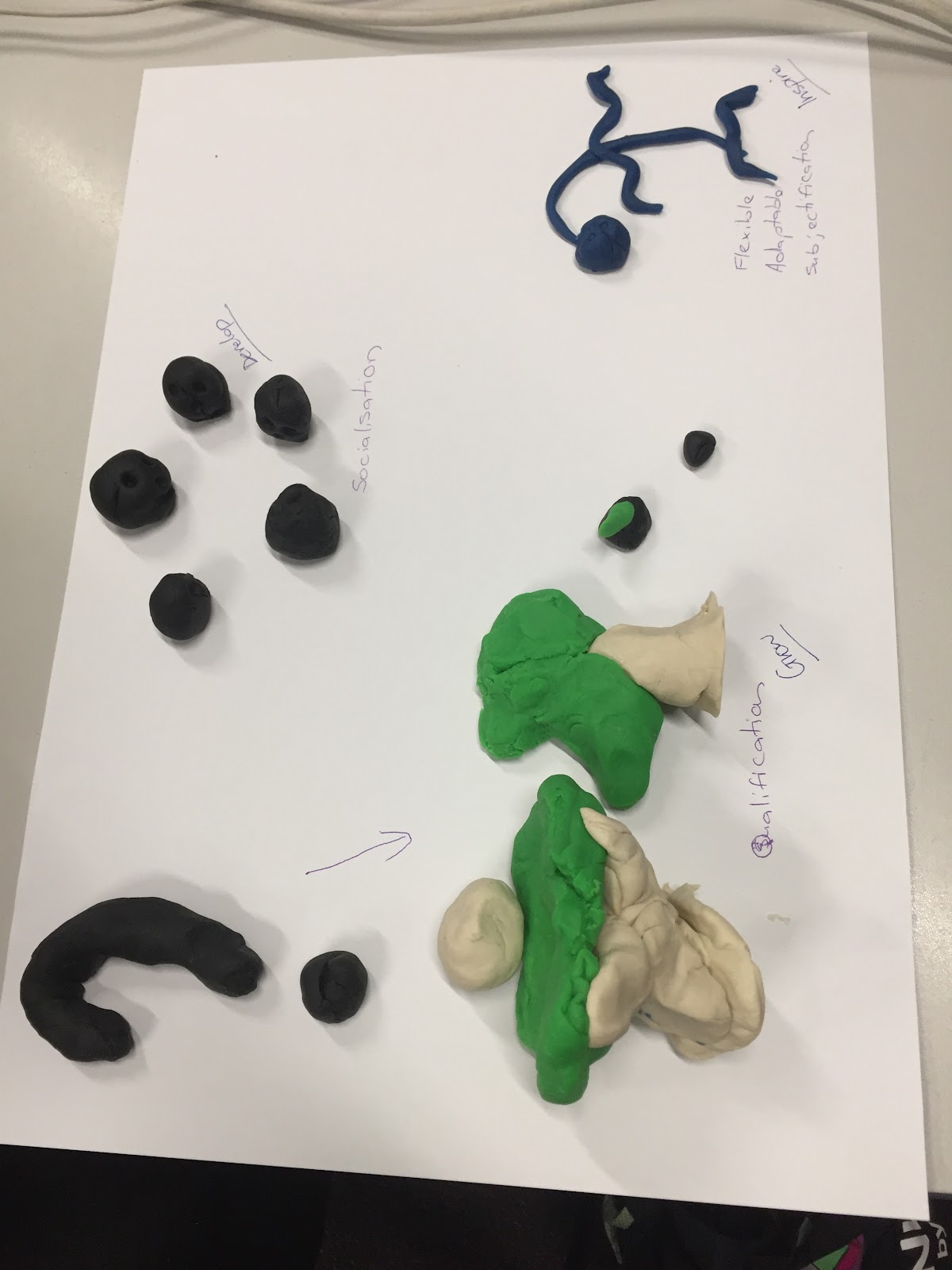
We were asked to put our ideas into three categories; we chose inspire, develop and grow. We then had to make a visual representative of our ideas.


Our play dough sculpture shows a seed, sprouting and growing into a tree - representing our students. We also included a group of children (the round black balls) representing collaboration and a flexible person showing that you are needing to be flexible and adaptable.


Gert Biesta’s ideas on purpose of education.

We viewed the following video and were then asked to reflect on our visual representation. We then discussed the three purposes for education and how that linked to our representation. Our growing trees represented Qualification, Collaboration represented Socialisation and flexibility represented subjectification.


Reflect on how your understanding of the purpose of education is visible in your classroom.


* I provide students opportunities to discuss their learning with peers. Allowing "think, pair, share" encourages students to develop their own ideas about their learning and compare it with that of their peers. This also encourages collaboration, as ideas my change or grow after sharing with others.

* We are continually striving to improve ourselves, setting personal goals and reflecting on them. Students need to consider how they are going to achieve their goals.

* As a junior syndicate, we provide students opportunities to work collaboratively within other classroom, using mix age/ability groups.


Improvements that can be made:


* Allowing students more opportunities to have a say in their learning, or the direction it is taking.

* To be leader, you need followers. For our students to be "Leader of learning", I need to allow more opportunities for them to lead, with me being their follower.