Tuesday, 1 August 2023

ADSA: Success in School Workshop: Day 2

 Numeracy & adapting the curriculum with Dr Rhonda Faragher

Teach the student the same math that is being taught in their level with adaptations or adjustments. Year level adjusted curriculum is about allowing kids to move past holes and perhaps fill them as they go.

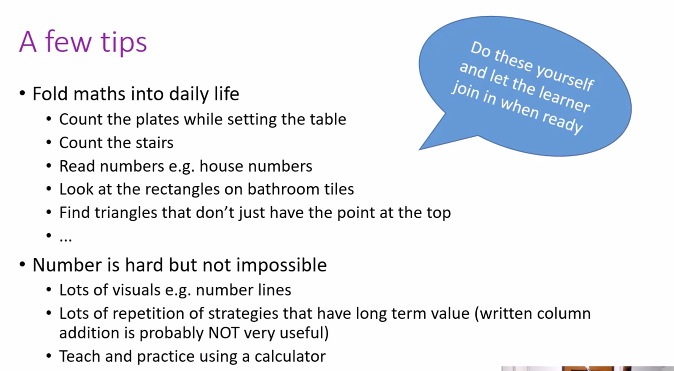
Our understanding of quantity gets pegged to the word (or the language). For children with down syndrome, we need to focus on the symbols. Visuals, such as number lines are essential. 

Problems with number may be a deficit in number processing. However, other areas of mathematics are accessible. 

Use calculators! Talking calculator as an app on the iPad can work wonders. 


Don't forget the other areas of maths! Geometry, statistics, algebra, etc.

Don't Test!

Low expectations have held learners back!
Numeracy in Practice – Numicon with Catherine Huxford

Why use numicon?
Maths is a subject about abstract ideas. People with Downs Syndrome find abstract concepts very difficult to grasp. Numicon works to the strengths of the learners, as they learn through visual. 

Teaching is modelling something, not asking children to show what they know. That is testing!

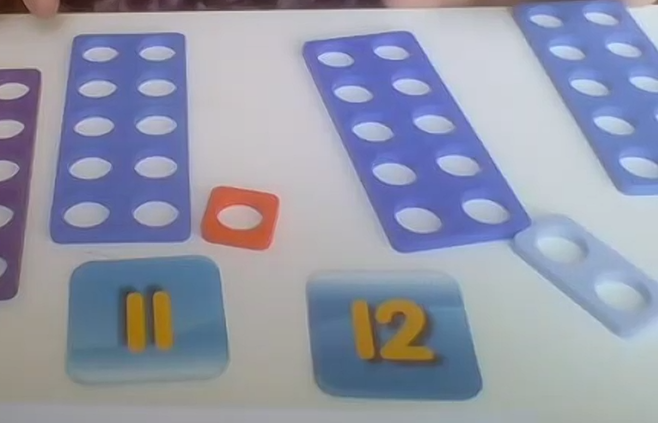
Using numicon, you can order them from smallest to biggest. You can identify the staircase and that numbers are getting bigger. Adding one more, I'm making the shape of one more (right next door). It is visual for children to see which is bigger. 

Great for identifying odd numbers with the sticky one bit. (LOL)
Addition, simply add the two bricks together. Find the block that is the same shape. Do not teach addition unless the children know that number names of the numicon shapes. 

Bonds to ten with the rainbow movement of the shapes. You can notice patterns here with stairs happening on both sides. 


Can look at place value too:


Another way of showing place value could be side by side. This will show the tens and the ones


We can look at fractions and decimals too! Consider the ten block to be one whole. So the one can become one tenth.


Using a base board, we can teach fractions and percentages too. The image below can show 57%.


Can show fractions. Show the connections between 1/6 and 2/12 (have two of these below)


Show the patterns between numicon and ten frames


Numicon isn't just shapes. It is an approach to teaching maths. 


Literacy and how to use the curriculum with Dr Sally Clendon


Use key words with common rimes. So for example when teaching ick words, they can associate it with a keyword like pick. From here, they will learn that they can also spell sick, lick, stick, etc. 

Within writing, we need to look at form and function. Here Rick is showing he has function and will move faster along with his learning in writing, compared to Brian, who hasn't learnt that he is writing his name.


Writing could be scribble! We need to see how they are progressing themselves, rather than using copying or tracing. It is critical that we don't skip over the need for them to understand they are conveying meaning through making marks on paper. 
Do not push any cognitive strain on students before they are motivated to write on their own, for example, don't worry so much about form or punctuation etc. 
Handwriting and writing should be taught separately. We do not want students to learn that handwriting is writing or that copying is writing. 

Using visuals to assist in accessing the curriculum with Fiona Kenworthy

Use visuals. We can create a student profile which they can share with others. Use visuals to show, because it is easier for them to understand and to share. 


Collaboration for Success – IEPs with Andrea Smart


Monday, 31 July 2023

ADSA: Success in School Workshop: Day 1

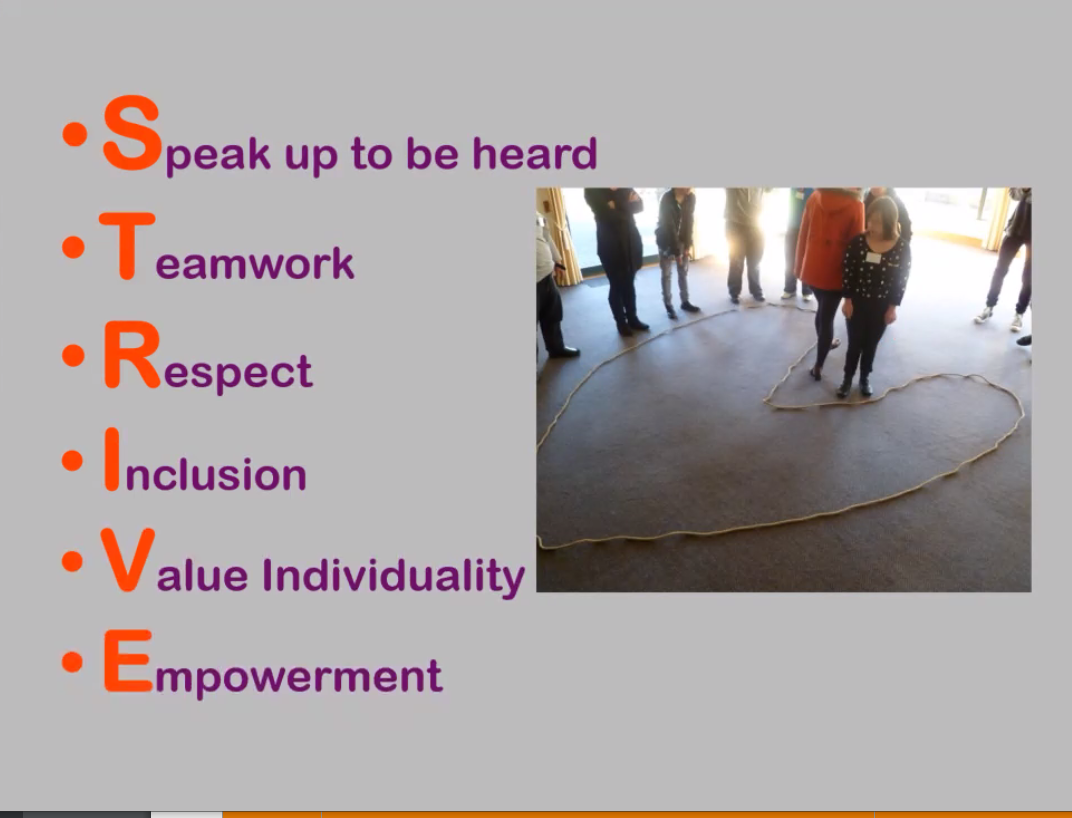
 Hearing from Edward Borkin, sharing his story growing up with down syndrome. He is a founding member of STRIVE, Their main goal is:


Universal Design for Learning with Dr Jude MacArthur

When planning, plan for everyone is mind, from the start. Focus on what they can do, rather than what they can't do. 

Things that can support children include:
  • Ensuring everything is in logical order.
  • Have instructions written down with steps (visuals important here)
  • Talk slowly and communicate clearly. Use sign. Teach this to the whole class!
  • Keeping background noises to a minimum. (Can encourage students to use headphones for a quiet space)
  • Give more time to process, especially during testing situations.
  • Front load where possible. 
We need to remove barriers! Focus on the universal solution that can benefit everyone in class. 


Learning profile of students with Down Syndrome with Paula Beguely

There can be many things that we need to consider when we have a child with down syndrome in our classroom. 


Hearing - Often children with down syndrome have smaller ears and smaller ear canals, making hearing harder for them. Glue ear can become a barrier too. This is often like trying to listen to someone talking underwater. 

Vision - Often children with down syndrome may need glasses. They also often confuse colours. They are not colour blind, but may confuse orange, red and brown etc. Ensure they see the colours you are seeing. 

Low Muscle Tone - Children can get tired easily. They may even need to rest against something or lay down. This may come across as behaviour or not managing self, but isn't!

Pain - This is something to discuss with families. There may be some confusion around what is happening and the feeling they are experiencing. There is a chance they may not be able to explain what they are experiencing or may not react as we would expect. For example, the presenters daughter had trapped her finger in the cardoor. She only reacted when her mum came outside to see where she was.

For this reason, all injuries need to be reported to the parents regardless of severity. 

Speech - this can be impacted from hearing barriers, cognitive conditions and low muscle tone. 

There may also be other medical conditions present. These need to be discussed with the families. 


Have visual prompts, time tables etc available for the students.  Also remember that it can take up to 10 seconds to process information or questions, so allow that time when asking questions. 

We also need to consider whether our students in our class may be sensory seeking or sensory sensitive.

Sensory seeking - jumping, crashing, banging into things, spinning, chewing on things, stomping, placing items heavily
Sensory Sensitive - school bell too loud, overreaction, unexpected things, difficulty with teeth brushing, haircuts.

As there can be loads of challenges and barriers, focus on the strengths of the students.
  • Visual awareness
  • Responds well to praise
  • Reading and Writing
  • Thrive with structure and routine

Ensure we teach things correctly from the start, because once it has been added to long term memory, it can be hard to unlearn!

Understanding & Supporting Behaviour with Arul Hamill


When dealing with behaviour, we need to be doing the noticing for the students. We need to notice their body signals and identify these with the students for them to be able to notice these themselves.  Students with down syndrome take longer for them to notice their own body signals. 


When there is a heightened feeling, for example student with anxiety, or feelings of anger etc, they can't always hear or process verbal feedback. Use visual cues as needed. 


Many students, regardless of illness or disability, struggle with physical calibration. This is something that we need to model and practice with our students. For example, What is gentle? Slow? How does it feel? This is especially important when looking at students running in the classroom, pushing in line etc. 

When looking at behaviours that are unwanted, look at the behaviour and what lead up to it. What is happening during and after. Discuss these with the students to develop that understanding.

Always teach a functional equivalent behaviour! For example, instead of hitting, encourage high fives. 


Friendships with Fehm Hussain 


Connections before content!

When trying to encourage friendships, rather than saying, "Who is looking after Child today?" instead say "Child is having a challenge today on the monkey bars to see how long they can hang on. Whose up for the challenge?" It removes the stigma that the child cannot make their own friends, or being helpless.

Ensure there isn't a heavy teacher-aide or adult presence all the time. We don't want to interfere with friendships forming on their own.

Teach problem solving skills rather than removing the problems. 

Could have a coreboard. With permissions from families, a photo of each child and their name can go home with the child so they can have conversations about friends at home with their fmailies. 

Things to consider:

High viz for duty teachers?
Often the students will gravitate towards the adults, but for the duty teacher to re-engage the students with other children.


Monday, 1 March 2021

2021 Teacher Inquiry

 It is five weeks into the term, and it is clear that there needs to be some work done around learning to read a word and sounding it out for spelling. After reading with all the students in the class, I have noticed a large group of students that are not able to chunk sounds together when reading, ie 'this' becomes 't' 'h' 'i' 's' rather than 'th' 'is' or 'th' 'i' 's'.  I have also noticed that students are reading words such as pressed, and sounding out both the 's' in the word. This makes it tricky for the students to put the sounds together.

During writing I have noticed when students sound out unknown words, they look nothing like what they sound. They are including sounds that are not part of the word, or missing important sounds. 

Therefore, for my inquiry during Term 1, I would like to look at introducing a daily phonics programme into our classroom and see if this will make a difference to the way in which students are able to decode a word and if it improves overall student spelling.

I will be selecting a group of students. These students would be tested using PM running records, have already completed STAR and will have a pseudoword test. They will then be receiving daily phonics instruction along with games to increase their understanding. They will be assessed again after 6 weeks to see progress; if any has been made.

Friday, 11 September 2020

DFI - Computational Thinking

 Today was a great day diving a bit deeper with computational thinking.


I had a go with lightbot. This certainly made me think. The first few levels were easy, but it certainly got harder quite quickly. It was great for debugging and thinking how I could improve my code. 


For the afternoon, we looked at creating a maze using Scratch. This is my creation below. I enjoyed being able to add in a second level. It was great for thinking outside the square and problem solving. 

Have a go at my game below. Use your mouse pointer to navigate the car through the maze.

Wednesday, 12 August 2020

Hapara Champion Educator

 So, since I'm stuck at home not able to drive or do anything else (thanks to ligament damage whilst playing netball), I thought I might as well complete my Hapara Champion Educator certificate.

This was a worthwhile experience, one I would recommend all teachers and facilitators do. I did know quite a bit about the dashboard and sharing facilities, but learnt a few more helpful tips and tricks. 


Now I can proudly display my Hapara badge alongside other my other badges. I wonder what badge I could earn next?


Friday, 7 August 2020

DFI Media

Today we shared the possibilities of media that you can use within your classroom and with your students. There are so many ways to engage students with their learning using Google Apps such as Draw, Slides and of course using the likes of YouTube for creating playlists of rewindable learning for the students.

I presented a breakout on creating pick-a-path stories. I always created my own as they were creating theirs, and I realised that I had left off some important information:
  1. Use the titles to name your slides. I did share this with them, but then forgot to show them how if they change the title, it makes it easier to find the right slide you are trying to link to.
  2. That all images and text boxes added to the slide will need to have a link back to the current slide so students can accidentally advance to the next slide.
  3. I made mention part way through their create that they can use images instead of shapes and text as answers. 
My presentation with instructions.


This is my creation. I'm wanting to do something similar with Ngataki school around blog commenting once we have had a lesson or two around this concept of Smart Relationships.