Sunday, 25 February 2018
Influence of Law & Ethics in Practice
Mindlab Activity 4
1 (What): An ethical dilemma that I have faced in the past is very similar to one of the issues discussion in one of the videos from this week's required activities, and relates to students being photographed/videoed and shared on social media.
At my school, we ask permission upon enrollment of students, for their child to be published on our school website, newsletters, school facebook page and pictures displayed around the school. A parent approached me oneday, annoyed, saying that 'their' child was on our school Facebook page and they were not happy about this. Originally they had signed for their child to be published online, but didn't think this meant social media. They further complained that other parents were taking photos at sports days, which included 'their' child, and were posted on social media. This was seen a more of a problem, as it was not only on our School Facebook page, but individual parents Facebook pages, which we had no control over.
Step 2 (So What): According to Ehrich, Kimber, Millwater & Cranston (2011) the following should be considered when being faced with this dilemma: professional ethics, legal issues or policies, organisational culture, the institutional context, the public interest, society and community, the global context, the political framework, economic and financial contexts. In my case, I went straight to find the original document that the parent had signed, to see if in fact ‘they’ had given permission for us to publish photos online - which they had. I further considered our organisational culture, the public interest, our local and wider community(ies), and asked myself whether removing all photos of this particular child was the best plan of attack.
Before moving further with this dilemma, I asked the meet with the parent again. We discussed what ‘they’ thought ‘publish online’ meant, and found it did not match the school’s description. With the parent, I discussed ‘their’ options. These included, a new form being signed saying that the school didn’t have permission to publish photos online. In doing this, ‘they’ would have to agree that he child could also not be in our school newsletters and school magazine, as these are shared with our whanau on our school Facebook page. Further to this, I posted on our school Facebook page that any photos other parents may have of students, would need to have my approval before being posted on our school Facebook page. This did not solve the issue of other parents posting pictures of their own children on Facebook, that may showcase this particular child. This was discussed as a staff at a staff meeting, with only one manageable solution, that this child be excluded from all EOTC activities.
All these solutions would allow this child to not be published online, however wasn’t being fair to the child as they would need to be excluded from many of the activities that would be showcased by the school, which included our “Caught Being Good’ Award. This would not be the best outcome for the child and they would miss out on much of what the other students would have access to.
Step 3 (Now What): The ideas were discussed with the ‘parent’, with the final decision left in ‘their’ hands. The parent decided that they too did not want their child to miss out on a quality education, and that photos in Newsletters and in the school magazine would be acceptable, because they aren’t directly loaded onto Facebook, but would prefer photos not to be loaded onto Facebook directly. As a school, we had to ensure that all parents understood our policy around photos/videos being taken, and reworded the policy to explicitly state the inclusion of Social Media as a media online.
Ehrich, L. C. , Kimber M., Millwater, J. & Cranston, N. (2011). Ethical dilemmas: a model to understand teacher practice, Teachers and Teaching: theory and practice, 17:2, 173-185, DOI: 10.1080/13540602.2011.539794

Tuesday, 5 December 2017
Communities of Practice
Mindlab Activity 3
The two topics I would like to focus my inquiry on is:
The two topics I would like to focus my inquiry on is:
- Flipped classrooms - How can this work effectively in a team-teach classroom environment?
- Digital portfolios - How to implement digital portfolios with students for the first time and what tool/medium would be of most benefit.
- How do the two chosen topics relate to issues in your professional practice?
Flipped classrooms have always been of interest to me. I like the idea that students are able to have a look at something in their own time, before the teaching happens in class. This is particularly useful for students that require information being ‘fed’ in different ways, or may need to hear the same information a few times. As our senior school will be involved with the Manaiakalani project next year, our students will have one-to-one devices, allowing for flipped learning. This then means that all the learning does not have to happen solely in the classroom. Parents can be involved with the learning also, creating a wider community of learning for the students. This also leads into the students being able to reflect on their own learning using blogs or digital portfolios. At the moment, our portfolios only serve the purpose of the teacher selecting ‘good’ pieces of work to showcase to parents/whanau. I would like to see students having more ownership of their own learning (Students agency) by choosing pieces to share themselves, and reflecting on these using their blogs or digital portfolios.
- How could Wegner’s model help you to identify some of your meaningful Communities of Practice?
Wenger et al. (2002), describes a Community of practice as a ‘group of individuals participating in communal activity, and experiencing/continuously creating their shared identity through engaging in and contributing to the practices of their communities’. He goes on further to say that “Communities of practice are a practical way to frame the task of managing knowledge. They provide a concrete organisational infrastructure for realising the dream of a learning organisation.” (Wenger, McDermott, & Snyder, 2002, Preface, para. 2). Therefore, the communities of practice I belong to include my syndicate team, Google+ Mindlab Community, Mindlab Kaitaia Community, RTLB and Manaiakalani.
- How would inquiring on those topics contribute and link to learning within your Communities of Practice? (e.g. your team, syndicate, CoL, online community, Mind Lab whānau, professional association)
By inquiring into my two topics - flipped classrooms and digital portfolios - I am supporting my syndicate community to work towards to best outcome for our students. As a syndicate, and as a school, we strive to develop each child into achieving their goals. Providing my understanding of 21st century learning and inquiring into best practise for my two topics, I can support our students to become self-directed 21st century learners that strive for more. I can also connect with Manaiakalani, as they will be working alongside a couple of our teachers to delve into their pedagogy into our classrooms. I can share my inquiry findings with them, and they can support me in areas that need development or even areas that I may not have considered.
Wenger, E., McDermott, R., & Snyder, W. (2002). Cultivating Communities of Practice: A Guide to Managing Knowledge. Cambridge, MA: Harvard Business School Press.
Sunday, 26 November 2017
A Change in My Practice Towards Future-oriented Learning and Teaching
Mindlab Activity 2
Theme 4: "Changing the script": Rethinking learners' and teachers' roles
Theme 4: "Changing the script": Rethinking learners' and teachers' roles
- Why did I make this change?
I have always been intrigued by the thought of children ‘driving’ their own learning. I wanted students to be able to take ownership of their learning and thus creating students that are engaged and motivated about learning because they choose the path their learning is taking. I wanted to empower students to be able to learning goals for themselves, and use the reflections of those to guide future learning. In my year 2/3 class, it has been very minimal, but already I can see that my students are setting goals based on their own needs. Often, they seek feedback from peers and collaboratively work out a next step/goal. This requires students develop self-regulatory skills. According to ITL Research (2012), “Today’s complex world demands self-regulated thinkers and learners who can take responsibility for their lives, their work, and their ongoing learning. It requires individuals to monitor their own work and to incorporate feedback to develop and improve their work products” (p.31)
- How was this change triggered during my learning journey at The Mind Lab?
Focusing on the 21st century learning skills has supported my decision for this change. I have previously heard about self-regulation or students agency, however didn’t understand the impact it could have on my students and my teaching. By developing my first assignment, I have had the opportunity to further grow my understanding of student agency and how it would benefit my students, not only now, but also into the future.
- What have I learned from implementing this change?
I have learnt that teaching self-regulation take times. It needs to be model explicitly to students. Students need to be given the time to practise this skill, to fail and try again. They need to be able to do this in an environment where failures are celebrated. By my students being able to set their own goals for writing, they no longer needed to be directed about what to focus on in writing. Instead of them coming to me, asking what needs fixing, they can now come to me and say, “I have used the same sentence starters for each of my sentences. I’m not sure how I can change some of these, I just can’t make them make sense”. I like the students will tell me what they need help with, rather than asking what needs improving. This allows students to think critically about their own writing and can apply to future situations where students are applying for jobs, going for interviews, etc.
At the start of next year, developing students agency is going to be my big focus. I would like to see my students leading their own learning in other curriculum areas such as reading, maths and topic studies. This could further be developed in students talking about their own learning and changing the focus of our parents - teacher interviews. Although we currently have three way conferences, the students are a little less prepared to discuss their learning with whanau as I would like.
ITL Research. (2012). 21CLD Learning Activity Rubrics. Retrieved from https://education.microsoft.com/GetTrained/ITL-Research
Sunday, 19 November 2017
Critical evaluation of my reflective practice.
Mindlab Activity 1
To be honest, written reflections are non-existent for me at the moment. I am constantly reflecting about my teaching and practice in the weirdest places - bed, shower, driving, while cooking, etc when writing things down just does not happen or practical. I often discuss concerns with peers to gain greater insight or new ideas. But critically reflecting, on paper, just isn't happening. I have tried to set time aside to complete reflections, I have bought diaries, every time they just gets pushed to the side - viewed as not important, purely because they take time, which there isn’t much going around.
To be honest, written reflections are non-existent for me at the moment. I am constantly reflecting about my teaching and practice in the weirdest places - bed, shower, driving, while cooking, etc when writing things down just does not happen or practical. I often discuss concerns with peers to gain greater insight or new ideas. But critically reflecting, on paper, just isn't happening. I have tried to set time aside to complete reflections, I have bought diaries, every time they just gets pushed to the side - viewed as not important, purely because they take time, which there isn’t much going around.
I wasn't sure how to start this blog post, so decided to have a look at what other people have said. Looks like many of us are focusing on the description, rather than the reflection. To support my critical reflection of my practice, I need to focus more on the ‘how’, ‘why’, and ‘so what’, rather than the ‘who, what and where’.
According to Zeichner and Liston’s (cited in Finlay, 2008) five levels of reflection, I would say I am currently sitting at level 2. I do from time to time ‘research’ (level 4) when I come across a challenge I have no idea how to solve, or a child with behaviour issues I can not manage. However, never have I critically reflected about this in writing.
SO
How - I am going to critically reflect using a variety of models, looking for a model that is successful and that works for me. One that is effective, but doesn’t require writing novels. Because according to Finlay (2009), “different models are needed, at different levels, for different individuals, disciplines and organisations, to use in different contexts” (p.10).
Why - Because with critical reflection, there is growth. Not only do you need to think retrospectively - what has been done, but also about what you are doing right now, and what you are going to do next time. It is with this thinking that we can ensure that we are always improving our teaching practise, looking for better, more effective ways to teach, learn and inspire others.
So what - According to Dewey (cited in Finlay, 2009) “reflective thinking moved people away from routine thinking/action (guided by tradition or external authority) towards reflective action (involving careful, critical consideration of taken-for-granted knowledge)” (p.3).
I am looking forward to making critical reflection a habit.
Finlay, L. (2009). Reflecting on reflective practice. PBPL. Retrieved from http://www.open.ac.uk/opencetl/files/opencetl/file…
Saturday, 22 July 2017
Mindlab Session 1: Leadership
What do you consider a good leader to be like?
After watching the above video, we (Mindlab Participants) discussed what we believed what we consider a good leader and a good follower?
Leader:
After watching the above video, we (Mindlab Participants) discussed what we believed what we consider a good leader and a good follower?
Leader:
- Leads in front of the class
- Encourages people to think for themselves
- Provide learning experiences to students
- Stond
- Decisive
- Humble
- Co-operative
Follower
- Can follow the leader
- Can take instruction and directions
- Collaboration
Being a good follower, can make you a greater leader.
Leader and follower may change roles at any given time
Reflection
For my students to be leaders of learning, I need to give them opportunities to lead when I follow.
Classroom Setup and Organisation Term 3, 2017
I have been thinking all holidays how I could make my classroom more spacious and to allow students some flexibility in where they work. After lots of thinking and trawling through pinterest for ideas, I have decided to remove my teacher's desk. This required some forward thinking as to where I would put all my 'stuff', but also where I would keep documentation that's usually on my desk.

This is now the front of my classroom. I had purchased a trolley from 'The Warehouse' and organised it will all my pens, markers, stickers, etc.
My next big challenge was creating a space that would allow more flexible seating for my students. In my room I had three lower tables (which I always used for storing 'stuff' on), and four large tables with chairs. Again, after ample thinking and rummaging through posts on pinterest, I decided to heighten one of my student tables.
 I used my three lower desks and created a collaborative working area with cushions to kneel on, I removed one of my large tables to create more room, placed chairs around one, and used blocks of wood to heighten one of my tables. This creates an area for students to lead or stand while they are working.

Against my wall, behind my standing table, I have display a VCOP wall (Vocab, Connectives, Openers, Punctuation) purchased on 'Teacherspayteachers'.
While working on the physical appearance of my classroom, I have also been thinking about ways to change the way my classroom functions, as well as how I teach and what I teach.
I have been viewing several videos relating to '21st century learners' and what is essential for them to learn. So my next big goal is to "Not teach content, but to teach skills needed to be innovative, independent, leaders of their own learning".
I hope the children are as excited as I am about our new learning environment.

This is now the front of my classroom. I had purchased a trolley from 'The Warehouse' and organised it will all my pens, markers, stickers, etc.
My next big challenge was creating a space that would allow more flexible seating for my students. In my room I had three lower tables (which I always used for storing 'stuff' on), and four large tables with chairs. Again, after ample thinking and rummaging through posts on pinterest, I decided to heighten one of my student tables.
 I used my three lower desks and created a collaborative working area with cushions to kneel on, I removed one of my large tables to create more room, placed chairs around one, and used blocks of wood to heighten one of my tables. This creates an area for students to lead or stand while they are working.
Against my wall, behind my standing table, I have display a VCOP wall (Vocab, Connectives, Openers, Punctuation) purchased on 'Teacherspayteachers'.
While working on the physical appearance of my classroom, I have also been thinking about ways to change the way my classroom functions, as well as how I teach and what I teach.
I have been viewing several videos relating to '21st century learners' and what is essential for them to learn. So my next big goal is to "Not teach content, but to teach skills needed to be innovative, independent, leaders of their own learning".
I hope the children are as excited as I am about our new learning environment.
Thursday, 20 July 2017
Mindlab Session 1: Purpose of Education!
So today we had our first session of Mindlab.
Our first collaborative task involved discussing "The Purpose of Education".
Purpose of Education - from Cheryl, Venessa, Penny and Natalie.
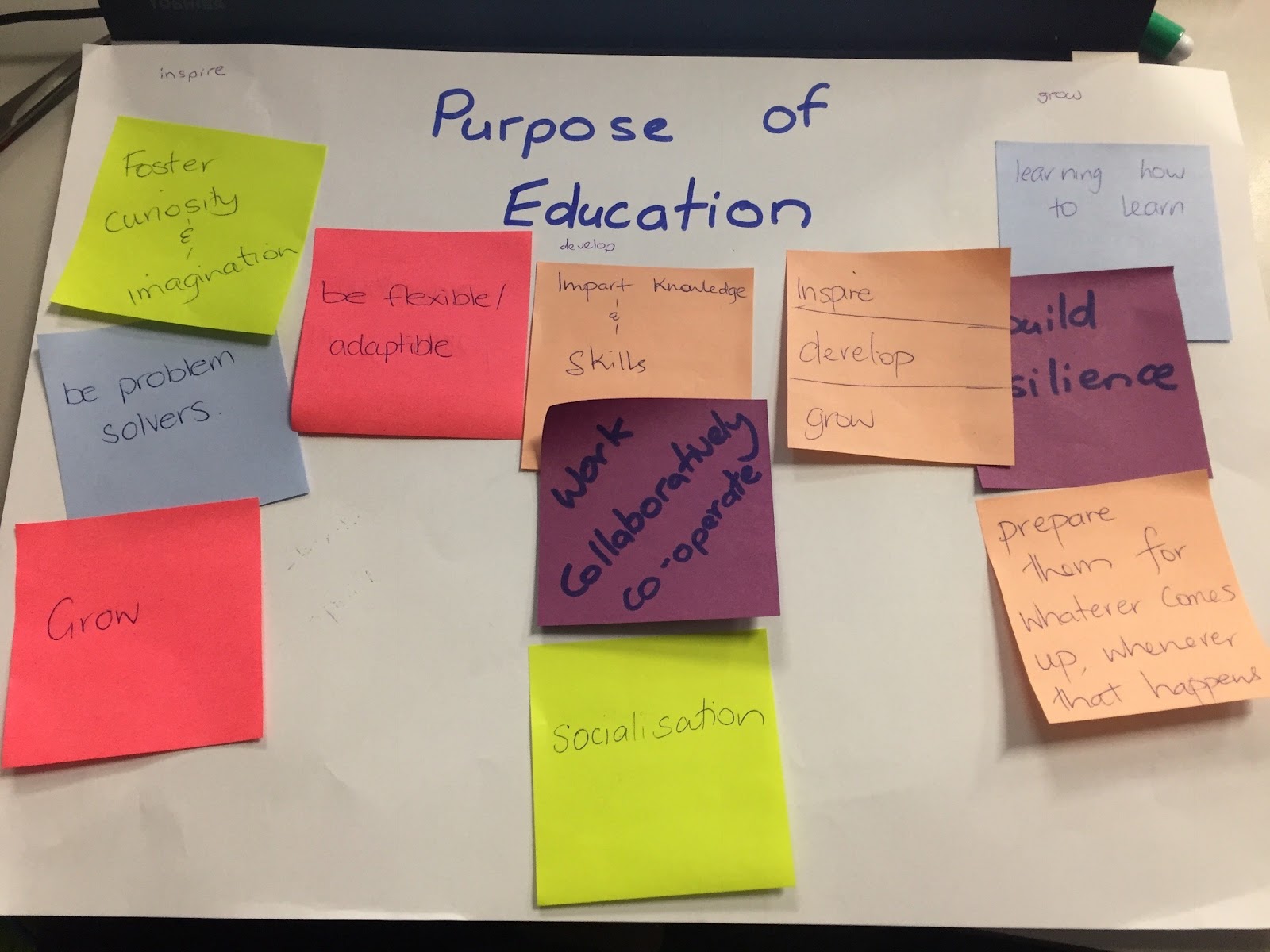
Our ideas included:
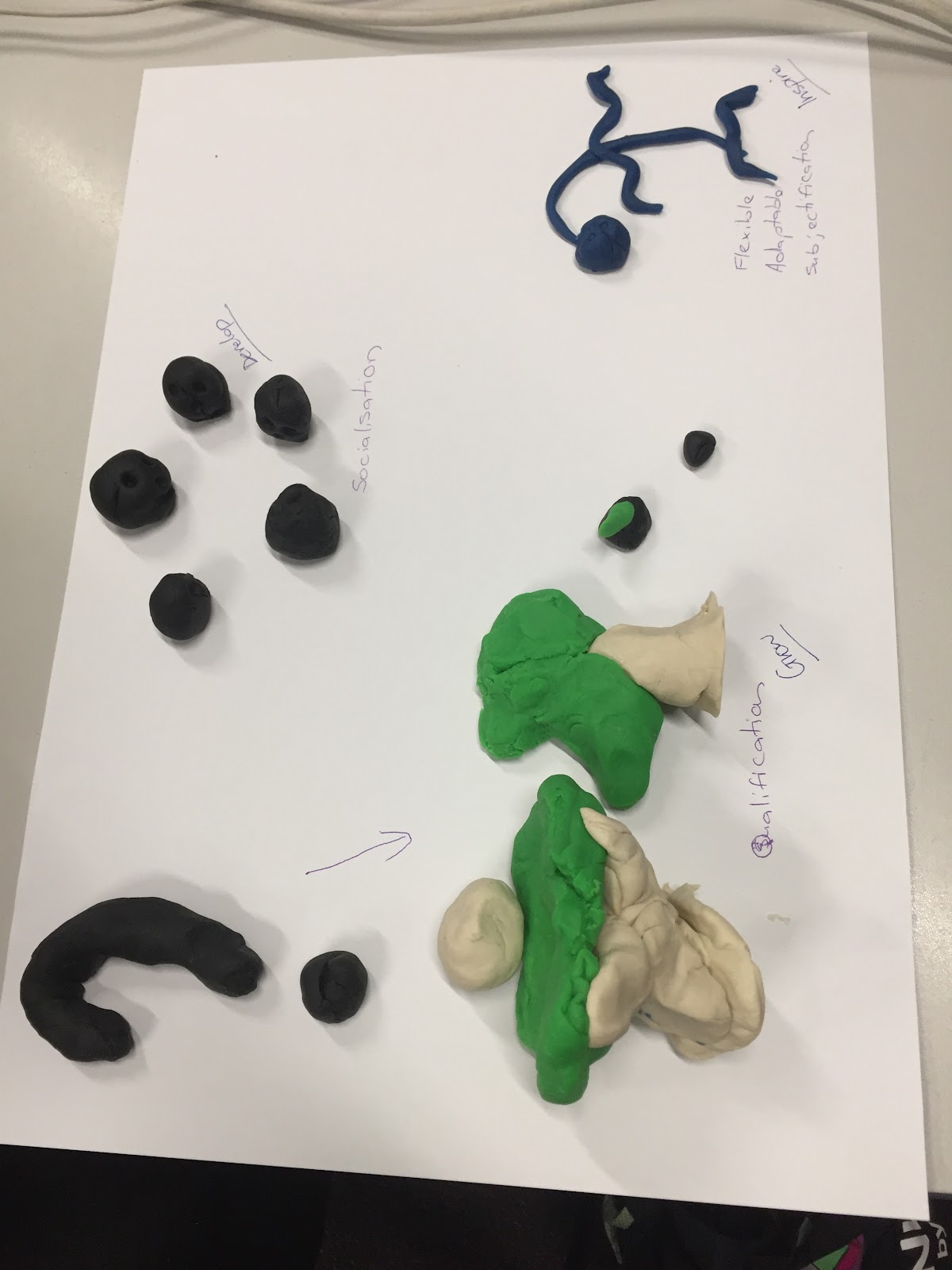
Our play dough sculpture shows a seed, sprouting and growing into a tree - representing our students. We also included a group of children (the round black balls) representing collaboration and a flexible person showing that you are needing to be flexible and adaptable.
Gert Biesta’s ideas on purpose of education.
We viewed the following video and were then asked to reflect on our visual representation. We then discussed the three purposes for education and how that linked to our representation. Our growing trees represented Qualification, Collaboration represented Socialisation and flexibility represented subjectification.

Reflect on how your understanding of the purpose of education is visible in your classroom.
* I provide students opportunities to discuss their learning with peers. Allowing "think, pair, share" encourages students to develop their own ideas about their learning and compare it with that of their peers. This also encourages collaboration, as ideas my change or grow after sharing with others.
* We are continually striving to improve ourselves, setting personal goals and reflecting on them. Students need to consider how they are going to achieve their goals.
* As a junior syndicate, we provide students opportunities to work collaboratively within other classroom, using mix age/ability groups.
Improvements that can be made:
* Allowing students more opportunities to have a say in their learning, or the direction it is taking.
* To be leader, you need followers. For our students to be "Leader of learning", I need to allow more opportunities for them to lead, with me being their follower.
Our first collaborative task involved discussing "The Purpose of Education".
Purpose of Education - from Cheryl, Venessa, Penny and Natalie.
Our ideas included:
- Foster curiosity and imagination
- To be problem solvers
- Grow in ourselves
- To be flexible and adaptable
- Inquire knowledge and skills
- Work collaboratively and co-operate
- Socialisation
- Build resilience
- Learning how to learn
- Prepare the for whatever, whenever!
Our play dough sculpture shows a seed, sprouting and growing into a tree - representing our students. We also included a group of children (the round black balls) representing collaboration and a flexible person showing that you are needing to be flexible and adaptable.
Gert Biesta’s ideas on purpose of education.
Reflect on how your understanding of the purpose of education is visible in your classroom.
* I provide students opportunities to discuss their learning with peers. Allowing "think, pair, share" encourages students to develop their own ideas about their learning and compare it with that of their peers. This also encourages collaboration, as ideas my change or grow after sharing with others.
* We are continually striving to improve ourselves, setting personal goals and reflecting on them. Students need to consider how they are going to achieve their goals.
* As a junior syndicate, we provide students opportunities to work collaboratively within other classroom, using mix age/ability groups.
Improvements that can be made:
* Allowing students more opportunities to have a say in their learning, or the direction it is taking.
* To be leader, you need followers. For our students to be "Leader of learning", I need to allow more opportunities for them to lead, with me being their follower.
Subscribe to:
Posts (Atom)