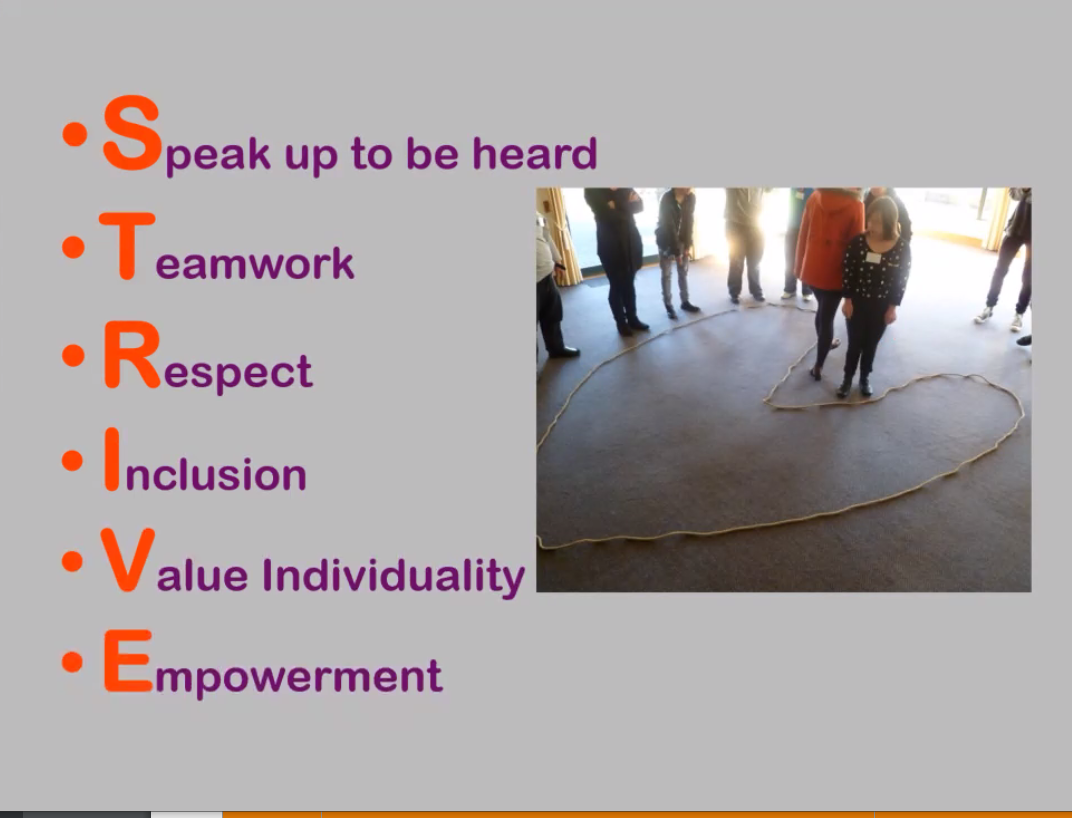
Hearing from Edward Borkin, sharing his story growing up with down syndrome. He is a founding member of STRIVE, Their main goal is:
Universal Design for Learning with Dr Jude MacArthur
When planning, plan for everyone is mind, from the start. Focus on what they can do, rather than what they can't do.
Things that can support children include:
- Ensuring everything is in logical order.
- Have instructions written down with steps (visuals important here)
- Talk slowly and communicate clearly. Use sign. Teach this to the whole class!
- Keeping background noises to a minimum. (Can encourage students to use headphones for a quiet space)
- Give more time to process, especially during testing situations.
- Front load where possible.
We need to remove barriers! Focus on the universal solution that can benefit everyone in class.

Learning profile of students with Down Syndrome with Paula Beguely
There can be many things that we need to consider when we have a child with down syndrome in our classroom.

Hearing - Often children with down syndrome have smaller ears and smaller ear canals, making hearing harder for them. Glue ear can become a barrier too. This is often like trying to listen to someone talking underwater.
Vision - Often children with down syndrome may need glasses. They also often confuse colours. They are not colour blind, but may confuse orange, red and brown etc. Ensure they see the colours you are seeing.
Low Muscle Tone - Children can get tired easily. They may even need to rest against something or lay down. This may come across as behaviour or not managing self, but isn't!
Pain - This is something to discuss with families. There may be some confusion around what is happening and the feeling they are experiencing. There is a chance they may not be able to explain what they are experiencing or may not react as we would expect. For example, the presenters daughter had trapped her finger in the cardoor. She only reacted when her mum came outside to see where she was.
For this reason, all injuries need to be reported to the parents regardless of severity.
Speech - this can be impacted from hearing barriers, cognitive conditions and low muscle tone.
There may also be other medical conditions present. These need to be discussed with the families.

Have visual prompts, time tables etc available for the students. Also remember that it can take up to 10 seconds to process information or questions, so allow that time when asking questions.
We also need to consider whether our students in our class may be sensory seeking or sensory sensitive.
Sensory seeking - jumping, crashing, banging into things, spinning, chewing on things, stomping, placing items heavily
Sensory Sensitive - school bell too loud, overreaction, unexpected things, difficulty with teeth brushing, haircuts.

- Visual awareness
- Responds well to praise
- Reading and Writing
- Thrive with structure and routine
Ensure we teach things correctly from the start, because once it has been added to long term memory, it can be hard to unlearn!
Understanding & Supporting Behaviour with Arul Hamill
When dealing with behaviour, we need to be doing the noticing for the students. We need to notice their body signals and identify these with the students for them to be able to notice these themselves. Students with down syndrome take longer for them to notice their own body signals.

When there is a heightened feeling, for example student with anxiety, or feelings of anger etc, they can't always hear or process verbal feedback. Use visual cues as needed.

Many students, regardless of illness or disability, struggle with physical calibration. This is something that we need to model and practice with our students. For example, What is gentle? Slow? How does it feel? This is especially important when looking at students running in the classroom, pushing in line etc.
When looking at behaviours that are unwanted, look at the behaviour and what lead up to it. What is happening during and after. Discuss these with the students to develop that understanding.
Always teach a functional equivalent behaviour! For example, instead of hitting, encourage high fives.


Connections before content!
When trying to encourage friendships, rather than saying, "Who is looking after Child today?" instead say "Child is having a challenge today on the monkey bars to see how long they can hang on. Whose up for the challenge?" It removes the stigma that the child cannot make their own friends, or being helpless.
Ensure there isn't a heavy teacher-aide or adult presence all the time. We don't want to interfere with friendships forming on their own.
Teach problem solving skills rather than removing the problems.
Could have a coreboard. With permissions from families, a photo of each child and their name can go home with the child so they can have conversations about friends at home with their fmailies.
Things to consider:
High viz for duty teachers?
Often the students will gravitate towards the adults, but for the duty teacher to re-engage the students with other children.


